



Application
- Polymeric foams are lightweight materials composed of a polymer matrix and gas bubbles. They offer low density, tunable mechanical properties, sound and heat insulation, and energy absorption.
- However, conventional fabrication methods such as mold casting and chemical reactions limit the achievable design complexity, restricting the potential for advanced or personalized applications.
Our Innovation
This technology enables the digital fabrication of stretchable, compressible, and flexible polymeric foams using 3D printing, specifically through stereolithography.
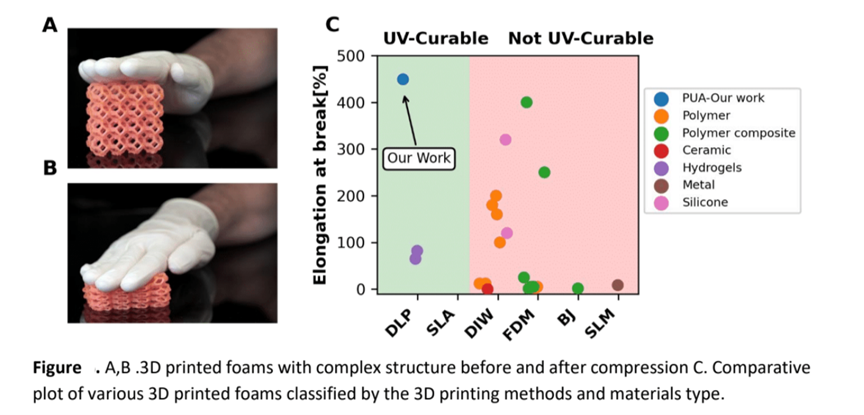
The foams are formed by localized photopolymerization of water-in-oil emulsions, where water droplets create the pores, and the continuous phase is a stretchable photocurable polyurethane. This process allows the creation of highly detailed porous structures with adjustable mechanical properties.
Advantages
- The water-in-oil emulsions are printed using Digital Light Processing (DLP), producing porous, stretchable, soft structures with high resolution.
- The printed objects feature three levels of porosity: intrinsic pores from the water droplets, interconnected pore networks, and cellular geometry defined by the 3D design.
- Mechanical properties can be finely tuned by adjusting emulsion parameters such as water content and pore size, as well as the elastomer composition.
- Functional materials can be embedded both in the pores and within the elastomer.
- New results show elongation-at-break reaching 450%, representing the highest reported value for 3D-printed porous structures.
- The foams withstand up to 80% compression with shape recovery, supporting reliable mechanical performance.
- Demonstrated thermal conductivity is ~0.026 W/mK, comparable to silica aerogels, making them suitable for thermal insulation applications.
- The technology extends to transparent porous γ-alumina structures with surface areas over 1800 m²/g, expanding potential into catalysis, optics, and filtration.
- The system enables the design of soft robotic components, such as actuators and grippers, with controlled deformation and mechanical responsiveness, demonstrated by successful object manipulation tests
Opportunity
This technology offers reliable, versatile materials for use in wearable protective equipment, impact resistance, thermal insulation, soft robotics, printed electronics, and smart packaging. Additionally, the emulsion-based approach can be adapted with other hyperelastic materials to create novel foams with complex architectures and tailored functionalities, opening avenues for commercial collaboration and licensing.