



Prof. Oded Shoseyov and Dr. Jonathan Bohbot, The Hebrew University of Jerusalem
| Category | Food Technology/Dairy Processing |
| Keywords | Bio-based mosquito repellant, bite prevention, skin camouflage, chemical camouflage |
| Current development stage | General list: TRL4 Technology validated in lab |
| Collaboration Opportunity | Seeking industry partnership for development and scale-up and Licensing |
Abstract
25 words the briefly describe main point of tech?
A sustainable, transparent nanocellulose coating forms a chemical camouflage on skin, significantly reducing mosquito bites and subsequent egg laying, especially when combined with the repellent indole.
Background
What is the domain of the invention or the technology (? What problem is addressed? Why it is critical? What are the current challenges in this area?
This technology addresses the urgent need for safer, more effective mosquito bite prevention. It tackles the limitations of current repellents—such as toxicity, odor, limited efficacy, and environmental concerns by using cellulose nanocrystals (CNC) as a biodegradable, transparent barrier that camouflages human skin from mosquitoes. Given the global burden of mosquito-borne diseases, this approach offers a sustainable, scalable alternative to existing chemical repellents, with potential for broader adoption and improved public health outcomes.
Our Innovation
State in one sentence what is the invention. (Method, new target, new approach, new software)
- List in bullet points 3-5 major advantages in terms of technological and functional excellence; if possible, in comparison to existing practice
A biodegradable nanocellulose-based barrier applied to the skin that camouflages human cues to reduce mosquito bites- based on a passive protective chemical camouflage along with active mosquito repelling molecules.
Major Advantages:
- Versatile camouflage mechanism: Acts by masking sensory cues mosquitoes use to detect hosts, in addition to active relying on volatile or irritating chemicals.
- Transparent and easy to apply: Forms a thin, invisible coating that is compatible with cosmetic formulations and daily use.
- Compatible with active repellents: Enhances effectiveness when combined with compounds like indole, enabling a synergistic protective effect.
- Environmentally sustainable: Fully biodegradable and water-soluble, offering a green alternative to petroleum-based materials like parafilm or graphene.
- Non-toxic and biocompatible: Unlike synthetic repellents, CNC is safe, odorless, and derived from sustainable plant sources.
Technology
Briefly describe the approach and the method proposed. Integrate images, if relevant
The technology involves the application of cellulose nanocrystals (CNC) as a biodegradable, transparent barrier that camouflages human skin from mosquitoes:
- CNC acts as a non-chemical, passive mosquito barrier through chemical camouflage.
- Combination with active repellents like indole is highly effective, enabling a hybrid protection system.
- CNC is safe, sustainable, transparent, and compatible with skin and cosmetic applications, making it a promising candidate for next-generation mosquito PPE (personal protective equipment).
Demonstrated results include:
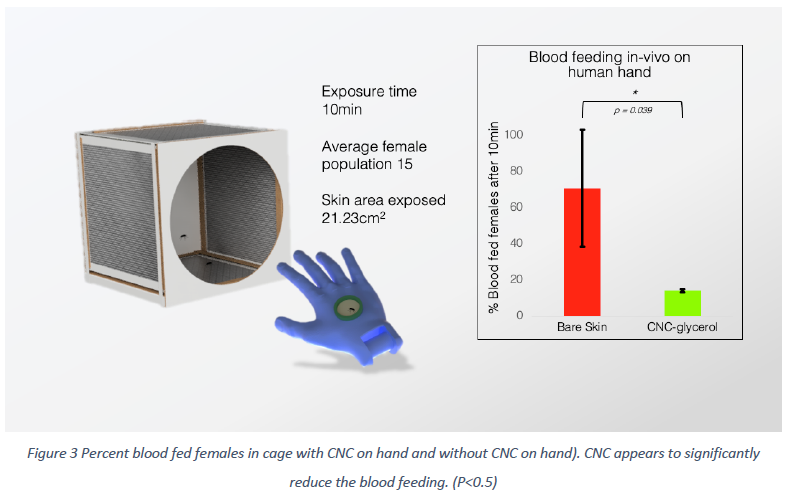
- CNC-glycerol coating reduced blood-fed mosquitoes by ~80% compared to bare skin.
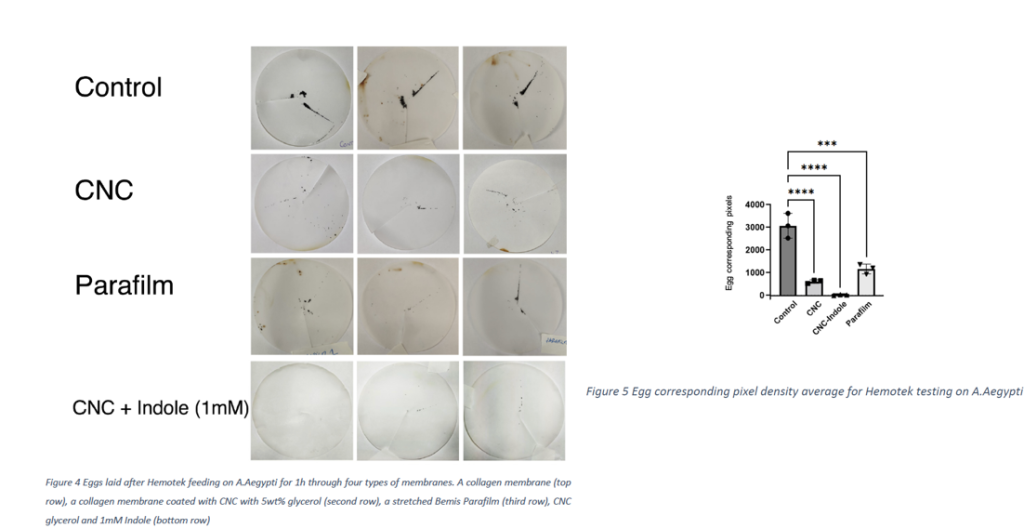
- CNC + Indole resulted in a 99.4% reduction in eggs laid, indicating strong synergistic effects between CNC camouflage and chemical repellents.
- Mosquitoes rarely land on CNC-coated skin, suggesting a chemical camouflage effect.
Opportunity
What is the expected impact or additional applications, if possible? Consider to relate to the way the technology strengthens the competitiveness and growth of companies by developing innovations, meeting the needs of specific markets or populations.
- Public Health Protection: The CNC-based barrier offers a safer, sustainable alternative to chemical repellents, directly addressing the needs of populations in mosquito-endemic regions—especially in developing countries where exposure to vector-borne diseases is highest.
- Cosmetic and Personal Care Markets: Its transparency, biocompatibility, and compatibility with active ingredients make it ideal for integration into cosmetic formulations, enabling multifunctional skin products such as sunblock + mosquito protection combinations.
- Agriculture and Veterinary Use: CNC formulations may be adapted to protect animals or crops from insect vectors, reducing the need for chemical pesticides or veterinary repellents.
- Military, Travel, and Outdoor Gear Sectors: Companies can leverage this technology to develop eco-friendly protective clothing and wearables for soldiers, travelers, and outdoor workers—markets where long-lasting, non-toxic mosquito protection is in high demand.
- Industrial Competitiveness and Growth: By meeting regulatory trends favoring green, biodegradable solutions, this innovation gives companies a competitive edge in global health, personal care, and biotech markets.
Patents & Publications
Patent Position: PCT/IL2023/051180
Scientific Articles:
- Mosquito bite prevention through self-assembled cellulose nanocrystals https://academic.oup.com/pnasnexus/article/2/4/pgad069/7103447
- Indole inhibits attraction in Aedes aegypti mosquitoes https://parasitesandvectors.biomedcentral.com/articles/10.1186/s13071-022-05545-8