



Application:
Osteoarthritis (OA) is a chronic, degenerative joint disease affecting 10–15% of adults over 60 years old. It leads to pain, reduced mobility, and a significant decline in quality of life. Current treatments mainly address symptoms and fail to halt disease progression. The absence of disease-modifying OA drugs (DMOADs) represents a major unmet medical need.
Our Innovation
We developed a novel CB2R-selective cannabinoid agonist to prevent and treat osteoarthritis. CB2 receptors are implicated in joint inflammation and pain. The compound show:
- High CB2R selectivity with no CB1R agonistic effect.
- Promising efficacy in preclinical models, including spontaneous and surgically induced OA in mice and rats.
- Strong in vivo performance in cartilage preservation and inflammation reduction.
- A clean safety profile and favorable drug-like properties.
A composition of matter patent has been filed (October 2021) securing IP protection through at least 2041.
Advantages:
- Disease-Modifying Potential: Early data support DMOAD capabilities, with improved joint structure and reduced osteophyte formation.
- Selective Mechanism: No CB1-related psychoactive side effects; high CB2 receptor specificity.
- Strong Preclinical Results:
- Reduced OA scores and degeneration in medial meniscal tear models.
- Effective in zymosan-induced inflammatory models.
- Favorable Pharmacology: High-yield synthesis, cost-effective, soluble, and stable.
- Versatile Administration: Demonstrated efficacy with intra-articular injection, minimizing systemic exposure.
Commercial Opportunity:
With over 240 million global OA patients and a market projected at $6.5B for knee OA alone, this technology addresses a high-demand, high-growth segment. Aging populations and lack of DMOADs fuel strong commercial potential.
Development Stage
Lead compound identified and tested in vitro and in vivo.
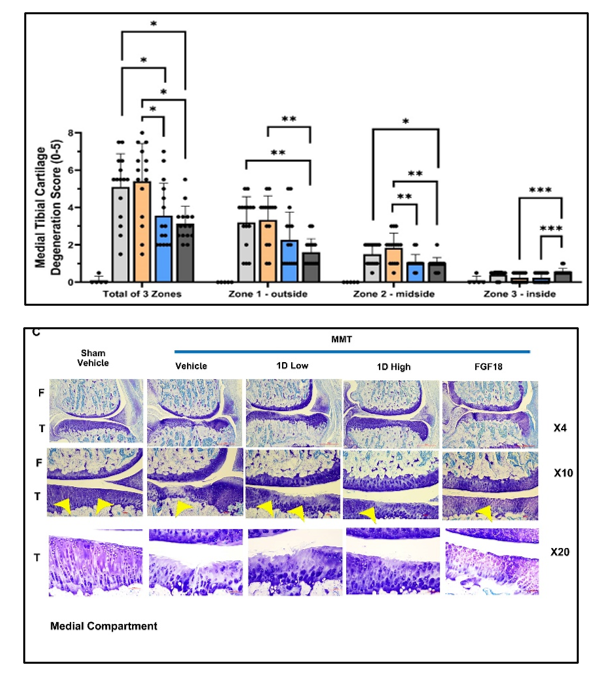
Upper graphs: MMT Histopathological Profiling and Cartilage Degenerative scores, based on post-sacrifice histopathological scores employed for the sagittal section of the medial tibial plateau, denoting total degenerative scores; Lower panel; Representative sections exhibiting dark blue–purple stains depict medial articular cartilage, while light green-blue staining is of connective tissue, bone, and marrow. Medial compartment is shown in magnifications of ×4, ×10, and ×20 for the tibial articular defect site. The left side of the depiction denotes “F” for femur and “T” for tibia. Statistical significance between treatments and control was examined via the Kruskal–Wallis test with a Dunn’s post hoc analysis for scored (non-parametric) parameters, considering p < 0.05 (*) to be statistically significant. ** p < 0.01; *** p < 0.001. Sham, n = 5; MMT-Vehicle n = 15; MMT-1D, low dose 8 μg n = 15; MMT-1D, high dose 24 μg n = 15; and MMT-FGF18 3 μg n = 15. Adapted from Carmon I, et al., Cells. 2022 Dec 16;11(24):4084. doi: 10.3390/cells11244084. PMID: 36552848.