



TTM: 16735
Friedler Assaf, Institute of Chemistry at the Hebrew University of Jerusalem
Yitzchaik Shlomo, Institute of Chemistry at the Hebrew University of Jerusalem
| Category | Electrochemical biosensors, Rapid pathogen diagnostics, Food safety technology, Peptide-based sensing platforms |
| Current development stage | General list: TRL4 Technology validated in lab |
| Collaboration Opportunity | Sponsored Research with an option to License Research Results |
Abstract
Peptide-based electrochemical biosensor enabling rapid, ultra-sensitive, and highly selective detection of Listeria monocytogenes via electrochemical sensor, delivering quantitative results within minutes.
Background & Unmet Need
The invention addresses the need for fast, highly selective, and ultra-sensitive detection of Listeria monocytogenes in complex samples. It addresses the critical need for fast, ultra-sensitive, and highly selective detection of Listeria monocytogenes, a dangerous food-borne pathogen that can cause severe illness and large-scale recalls. Current detection methods rely on culture, PCR, or immunoassays, which are slow, labor-intensive, and often insufficiently sensitive for early contamination, where many current rapid biosensors detect only at 10²–10³ CFU/ml. This invention addresses current diagnostic limitations by replacing these slow, culture-based workflows and complex antibody or nucleic acid assays with a rapid, label-free electrochemical sensing platform.
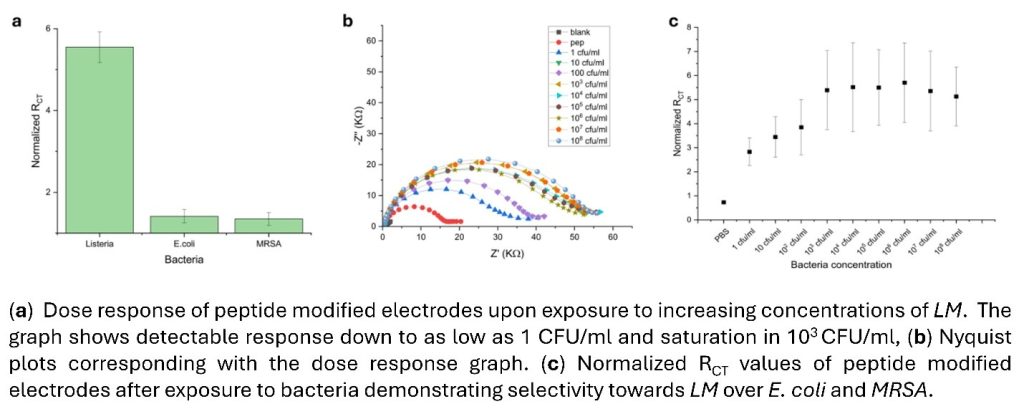
The sensor directly measures changes in charge-transfer resistance when bacteria bind to short synthetic peptides immobilized on a gold electrode. These peptides are rationally designed around the natural host–pathogen interaction mechanism, which provides exceptional molecular selectivity and minimizes cross-reactivity. The platform achieves ultra-high sensitivity down to sub-CFU per mL levels within approximately 10 minutes, enabling early contamination detection.
Our Innovation
A novel peptide-based, electrochemical biosensing method for rapid and ultra-sensitive detection of Listeria monocytogenes based on rationally designed host–pathogen interaction peptides.
Major technological and functional advantages
- Ultra-high sensitivity – detection down to ~0.5 CFU/mL, significantly lower than many antibody or antimicrobial peptide sensors
- Rapid results – quantitative detection within ~10 minutes versus hours to days for culture or PCR
- Exceptional selectivity – recognition derived from a unique interaction, minimizing cross-reactivity
- Electrochemical Detection Methods – no antibodies, enzymes, or nucleic acid amplification required
- Scalable and cost-effective – short synthetic peptides offer improved stability, lower production cost, and easier manufacturing compared to antibodies
Technology
The proposed approach is based on mimicking a natural protein-protein interaction to achieve highly selective bacterial detection. When bacteria bind to the peptide-functionalized surface, they induce measurable changes in interfacial charge-transfer resistance. These changes are quantified using electrochemical impedance spectroscopy, enabling rapid, , and highly sensitive detection without the need for culture, amplification, or secondary labeling steps.
Commercial Opportunity
This technology enables rapid, ultra-sensitive pathogen detection directly at the point of need, allowing food & feed manufacturers, supply chain operators, and hospitals to test and receives results in minutes instead of days. It can reduce recall risk, improve quality control speed, and strengthen regulatory compliance, enhancing competitiveness and operational efficiency. The low-cost, device-compatible format supports frequent routine testing in industrial settings. Furthermore, because the peptide recognition element is programmable, the platform can be adapted to detect additional pathogens, opening opportunities in multiplex food safety, environmental monitoring, and clinical diagnostics.
Patents & Publications
Pre-Publication: Rapid Electrochemical Biosensing of Listeria monocytogenes Using Rationally Designed Host–Pathogen Interface Peptides. Provisional Patent in drafting
Contact in Yissum
Ilya Pittel, Ph.D. | VP of Business Development
AgTech, FoodTech, Veterinary & Environmental Sciences
Yissum, The Technology Transfer Company of
The Hebrew University of Jerusalem
T + 972.2.658.6693 | M +972.54.782.2354 Hi-Tech Park, Edmond J. Safra