



Abstract
25 words the briefly describe main point of tech?
Water-soluble polyphenol salts achieve 112-140% cell proliferation enhancement, replacing expensive protein growth factors in cultivated meat production at dramatically reduced costs.
Background & Unmet Need
What is the domain of the invention or the technology (? What problem is addressed? Why it is critical? What are the current challenges in this area?
The cultivated meat industry faces a critical bottleneck: production costs. Growth factors represent 55-95% of total production costs, with fibroblast growth factor (FGF-2) alone costing $100-500 per gram¹. Current media formulations require expensive recombinant proteins including FGF-2 (100 mg/L), insulin (19.4 mg/L), and transferrin (10.7 mg/L), making commercial viability challenging.
Key Market Challenge: The global cultivated meat market, projected to reach $25.2 billion by 2030, remains constrained by media costs of $50-500 per liter. Leading companies continue struggling with media cost reduction, with most focusing on bioreactor optimization rather than fundamental media component replacement.
Our Innovation
State in one sentence what is the invention. (Method, new target, new approach, new software)
- List in bullet points 3-5 major advantages in terms of technological and functional excellence; if possible, in comparison to existing practice
We have developed water-soluble polyphenol salts that mimic protein growth factors, enabling direct replacement in serum-free cultivated meat media.
Major Technological Advantages:
- Cost Reduction: 90-99% lower production costs compared to recombinant growth factors – polyphenol raw materials cost $10-50/kg versus $100,000-500,000/kg for recombinant proteins
- Superior Performance: Na-Quercetin achieves 117% proliferation increase, K-Naringenin shows 130% enhancement, outperforming standard FGF-2 protocols
- Scalable Manufacturing: Simple salt synthesis process with >80% yields, eliminating complex bioreactor-based protein production
- Enhanced Stability: Polyphenol salts remain stable in solid form without refrigeration requirements, reducing storage and transport costs by 60-80%
- Regulatory Advantage: Natural polyphenol derivatives face lower regulatory hurdles compared to genetically engineered proteins
Economic Impact: Based on current cultivated meat production projections, this technology could reduce media costs 10 to 100 fold, potentially enabling price parity with conventional meat. For a medium-scale facility producing 1,000 tons annually, this represents $50-100 million in annual cost savings.
Technology
Briefly describe the approach and the method proposed. Integrate images, if relevant
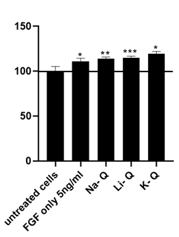
Screening Synthesized Polyphenolates for Effects on NIH/3T3 Cells Proliferation Cluster 1
For each polyphenol and its derivative: Quercetin (cell proliferation is presented as a relative fold-change when compared with that of the untreated serum-starved cells under similar experimental conditions. Absorbance readings at 570 nm were recorded in 4-5 replicates and averaged.
Our approach converts naturally occurring polyphenols (quercetin, naringenin, luteolin) into water-soluble sodium and potassium salts through simple base reaction chemistry. These engineered molecules activate key cellular pathways including PI3K/AKT, MAPK-ERK, and Wnt signaling – the same pathways targeted by expensive protein growth factors.
Validated Results:
- NIH 3T3 cells: 112-130% proliferation increase at 0.01-0.1 nM concentrations
- Bovine mesenchymal stem cells: 133-140% proliferation enhancement
- 3D spheroid cultures: 209% growth improvement with optimized formulations
- Multiple cell lines tested including bovine and mouse.
The technology includes scalable synthesis protocols (demonstrated at 50-60g batches) and nanoparticle formulations for enhanced bioavailability.

Commercial Opportunity
What is the expected impact or additional applications, if possible? Consider to relate to the way the technology strengthens the competitiveness and growth of companies by developing innovations, meeting the needs of specific markets or populations.
The researchers seek an industry partner to sponsor additional R&D and scale manufacturing processes. The partner will receive an exclusive option to license the intellectual property upon completion of development milestones.
Target Applications:
- Cultivated beef, chicken, and seafood production
- Cell culture media manufacturing
- Tissue engineering and regenerative medicine

Effects of Promising Different Synthesized Polyphenolates on AD-MSC Cell Proliferation Normalized to the Control. Cell proliferation is displayed as a relative fold change as compared to that of untreated serum-starved cells without and with insulin-transferrin-selenium (ITS).
Patents & Publications
Provisional Patent filed.
Contact in Yissum
Ilya Pittel, Ph.D. | VP of Business Development
AgTech, FoodTech, Veterinary & Environmental Sciences
Yissum, The Technology Transfer Company of
The Hebrew University of Jerusalem
T + 972.2.658.6693 | M +972.54.782.2354
Hi-Tech Park, Edmond J. Safra Campus, Givat Ram