



Unmet Need:
- The CB1 receptor (CB1R), part of the endocannabinoid system, is overactive in many diseases including cancer (breast, ovarian…) or metabolic disorder.
- Traditional CB1R blockers can cause undesired effects in the brain and lose effectiveness over time.
- There is a strong need for a safer, longer-lasting solution that targets CB1R only outside the brain, where it promotes tumor growth.
Our innovation:
- We develop a new class of molecules (PROTACs) that cleave the CB1R protein, instead of merely blocking it.
- Our leading compound, Pro-CB8, efficiently and selectively degrades CB1R in breast cancer cells, shutting down cancer-driving signals.
- The compounds were designed to be peripherally selective, meaning they do not cross the blood–brain barrier, reducing safety concerns.
Advantages:
- Effective removal of CB1R: up to 80–90% reduction of the target receptor in breast cancer cells.
- Stops cancer signaling: strong decrease in AKT and ERK pathways, and lower levels of key growth-promoting proteins.
- Stronger anticancer effect: reduces cell growth and survival and increases cell death, both in standard cell culture and in 3D tumor models.
- Outperforms existing drugs: shows much greater activity than the approved CB1R blocker Rimonabant.
- Safety potential: compounds show no significant brain exposure in animal studies, supporting their non-CNS, peripheral selectivity.
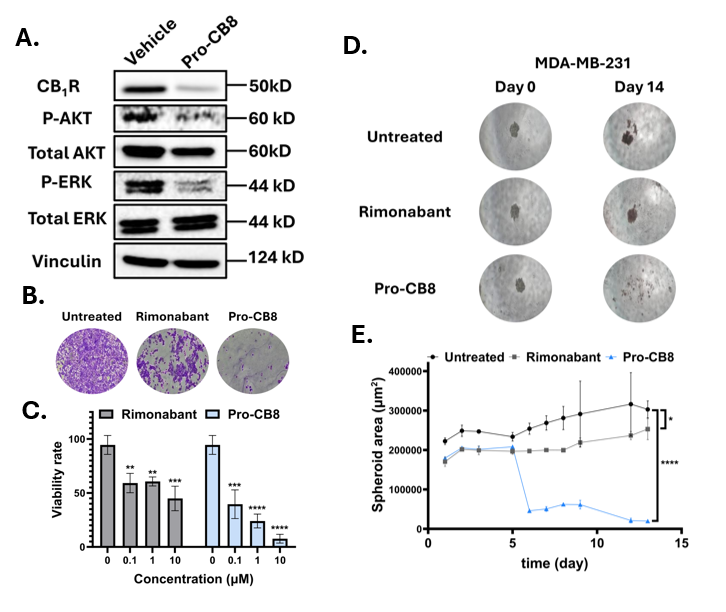
Figure: Evaluation of Pro-CB8 activity in breast cancer cells. (A) Western blot analysis showing the effect of Pro-CB8 on CB₁R signaling in MDA-MB-231 cells. Treatment with Pro-CB8 markedly reduced CB₁R expression and phosphorylation of AKT and ERK, without affecting total protein levels. Vinculin was used as a loading control. (B) Representative crystal violet staining of MDA-MB-231 cells treated for 72 h with Rimonabant or Pro-CB8 (10 μM) compared to untreated control, showing a pronounced reduction in cell density upon Pro-CB8 treatment. (C) Quantification of cell viability by crystal violet assay after 72 h treatment with increasing concentrations (0–10 μM) of Rimonabant or Pro-CB8. Data represent mean ± SEM of three independent experiments (**p < 0.01, ***p < 0.001, ****p < 0.0001 vs untreated). (D) Representative bright-field images of 3D MDA-MB-231 spheroids at day 0 and day 14 under different treatments. Pro-CB8 markedly inhibited spheroid growth compared to untreated and Rimonabant-treated groups. (E) Quantification of spheroid area over time showing sustained growth inhibition and shrinkage in Pro-CB8–treated spheroids compared with controls. Data are mean ± SEM (n = 3; *p < 0.05, ****p < 0.0001).
Commercial Opportunity:
- We seek collaboration with biopharma or biotech partners developing therapies in oncology or other CB₁R-associated diseases, with a particular focus on GPCR degradation, endocannabinoid signaling, and precision oncology.
- Potential pathways: sponsored research, option/license for composition-of-matter and methods; co-development for lead optimization, PK/PD, in vivo efficacy in CB1R-high tumor models; companion Dx for CB1R expression stratification.
Contact in Yissum: Ariela Markel