



Unmet Need:
- HuR (ELAVL1) is an RNA-binding protein (RBP) that stabilizes oncogenic mRNAs, promoting cell proliferation, survival, and metastasis in breast cancer.
- HuR overexpression correlates with poor prognosis, but it is challenging to inhibit due to its conformational flexibility.
- Existing inhibitors fail to fully suppress HuR function and suffer from off-target effects and limited therapeutic windows.
- There is an unmet need for selective, druglike compounds that degrade HuR rather than merely inhibiting it.
Our innovation:
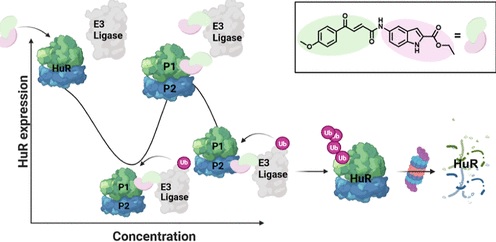
- Development of MG-HuR2, a molecular glue degrader that induces proteasome-dependent degradation of HuR by recruiting the E3 ligase RNF126.
- Development of PRO-HuR3, a potent PROTAC targeting HuR via dual-pocket engagement and cereblon recruitment.
- Both degraders show a unique biphasic degradation profile by binding two distinct RNA-binding pockets on HuR, enhancing efficacy and selectivity
Advantages:
- High specificity: Selectively degrades HuR without affecting non-tumorigenic cells (e.g., MCF-10A)proof_HuR degraders.
- Dual-pocket mechanism: Enables sustained degradation and overcomes typical hook effect limitations seen in conventional PROTACsproof_HuR degraders.
- Downregulates oncogenic targets: Reduces expression of Bcl2 and FOXQ1, key genes involved in apoptosis resistance and invasionproof_HuR degraders.
- Inhibits cancer phenotypes: Suppresses cell proliferation, enhances apoptosis, and reduces spheroid growth in 3D breast cancer modelsproof_HuR degraders.
- Druglike properties: MG-HuR2 complies with Lipinski’s, Pfizer’s, and GSK’s druglikeness criteria—the only compound in the study to meet all three
Commercial Opportunity:
- We are seeking collaboration with pharmaceutical and biotech companies pursuing RNA-targeted cancer therapeutics, particularly in breast cancer.
- This work pioneers the use of molecular glues to degrade RNA-binding proteins, a class previously considered undruggable.
- MG-HuR2 is a promising lead candidate for preclinical development, with broad potential to address other RNA-driven malignancies.
Contact in Yissum: Ariela Markel