



Application:
- RNA-binding proteins (RBPs) regulate RNA stability and translation and play a key role in cancer progression
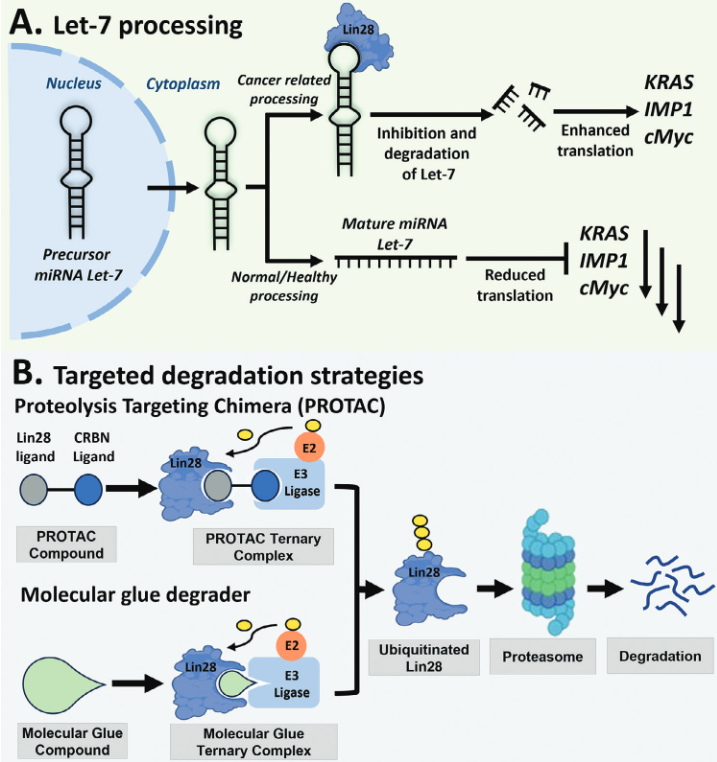
- The oncogenic RBP Lin28 suppresses let-7, a tumor-suppressor microRNA
- Lin28 overexpression is associated with aggressive cancer phenotypes, particularly in ovarian cancer
- Small-molecule modulation of protein–RNA interactions remains highly challenging
- There is an unmet need for novel therapeutic modalities that directly eliminate oncogenic RBPs
Our innovation:
- We develop small-molecule degraders that directly target the oncogenic RNA-binding protein Lin28, rather than merely inhibiting its activity.
- The technology employs two complementary degradation strategies:
- PROTAC-based degraders, which recruit an E3 ubiquitin ligase to Lin28 and induce its proteasomal degradation.
- Molecular glue degraders, which promote the interaction between Lin28 and an E3 ligase without the need for a linker, resulting in efficient target degradation.
- By inducing physical elimination of Lin28, the degraders disrupt the Lin28–let-7 complex, leading to restoration of let-7 tumor-suppressor activity.
- The compounds were intentionally designed as drug-like small molecules, maintaining low molecular weight and compliance with Lipinski’s rules, despite their degradation functionality.
- This approach converts a previously validated Lin28 binder into a catalytic degrader, enabling sustained biological effect through repeated target turnover.
Advantages:
- First reported small-molecule degraders of an oncogenic RBP
- Targeted protein degradation rather than inhibition
- Catalytic mode of action, enabling efficient Lin28 depletion
- Molecular glue degraders demonstrated higher cellular potency compared to binder controls
- Significant reduction of Lin28 levels observed in cancer cell assays
- Improved drug-like properties compared to conventional PROTACs
- Potential applicability to additional Lin28-driven cancers
Commercial Opportunity:
We are seeking collaboration with pharmaceutical companies interested in the development of new compounds that can lead to the development of more effective and targeted cancer treatments, potentially improving patient outcomes and survival rates.
Contact in Yissum: Ariela Markel